

Home > Newsletters > Break’in News September 2025

Newsletter - September 2025
In this newsletter: the Kinéis constellation is fully operational, a focus on monitoring hydraulic infrastructure, the start of deploying wildfire detection solutions, and a deep dive into Direct-to-Device in our new blog post.


OPEN NETWORK – CONNECTIVITY AVAILABLE
Your critical data, anywhere. Smarter decisions, anytime.
Since early June, we have opened and progressively brought online our satellite network dedicated to IoT and AIS. All summer long, our teams have been making continuous optimizations to ensure robust, high-performance connectivity. Today, our solution is operational and already supports numerous use cases.
Key advantages
- Satellites in position, in low Earth orbit
- Sovereign, 100% French solution
- Optimized for low data-rate operation
- “Fit and forget” simplicity
More than 20,000 devices are already connected to our network—including those from our partners CLS and Track Value—for essential and varied applications: environmental protection, fisheries activity monitoring, and logistics traceability.


HYDRAULIC INFRASTRUCTURE
Reduce leaks and call-out costs—even in coverage dead zones
Up to 30% of water is lost in some areas due to late detection. Globally: 126 billion m³ of water lost every year—nearly 39 billion dollars.
In regions with little or poor coverage, critical assets (reservoirs, buried pipelines, pumping stations) remain off the radar: late detection, costly patrol rounds, decisions made in the dark. Maintenance is reactive—a model that weighs on budgets and performance.
When every remote site becomes visible
With Kinéis satellite IoT, sensors send their data directly via satellite: pressure, flow, level, temperature, geolocation, critical thresholds. The information is encrypted, stored in the cloud, and integrated into your business tools.
- Accelerated anomaly detection
- Automatic alerts to mobilize the right team at the right time
- Predictive, targeted, and cost-effective maintenance
- Up to 30% of water losses avoided
Download our detailed study to learn everything about Kinéis monitoring solutions.
Others Use Cases

IoT forest fires
IoT & forest fires: Swiftly detecting wildfires in remote areas, a mission made possible by Kinéis’ satellite IoT.

Multimodal Transport
Track your assets anywhere in the world. Discover how satellite IoT brings full visibility back to your supply chain.

Small-scale sustainable fishing: Space IoT for authorities
Optimize artisanal fishing monitoring with Nemo, for real-time tracking and enhanced safety at sea.

Infrastructures networks IoT
Discover how IoT is transforming the monitoring of high-voltage lines for enhanced safety and efficiency in the electricity sector.

IoT tracking Freight Cars
Monitor and track your railcars in near real-time with Kinéis connectivity, for more efficient and sustainable railway transportation.


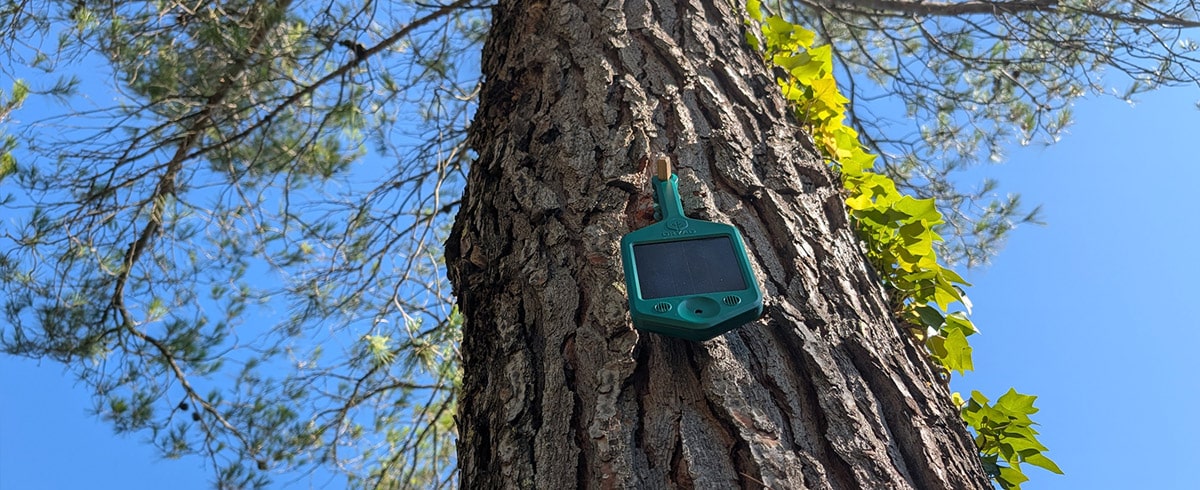
EARLY WILDFIRE DETECTION
First deployments in France
Kinéis and Entente Valabre are deploying—under the France 2030 program—a system designed to detect fire outbreaks as early as possible and to continuously monitor the water and retardant stocks essential to the French fire and rescue services (SDIS). The goal is clear: alert faster and secure operations, including in coverage dead zones.
This summer, at the Pont du Gard site (southern France), more than 120 Silvanet Dryad sensors were installed over 313 hectares with the firefighters. Connected to the Kinéis constellation, they transmit alerts to civil protection services from the combustion phase onward—even where terrestrial networks are absent.
In parallel, sensors placed on tanks track water levels in remote areas (resupply and logistics) and retardant levels at air-tanker reload bases, strategic points for replenishing aerial assets—helping anticipate resupply and accelerate operational decision-making.
“It’s the Minority Report of wildfire,” sums up Lieutenant-Colonel Philippe Meresse, Director of the Innovation Center at Entente Valabre. As summers continue to be marked by major fires, this approach saves precious minutes, optimizes resource deployment, and strengthens the protection of wildlife, flora, and communities.
Next step: expand the system to more than 10,000 sensors in France starting with the next fire season.


DIRECT-TO-DEVICE, WHAT’S THAT?
Satellite connectivity at device level, anywhere
Off-grid SOS, sensors in the middle of the ocean, vehicles in coverage dead zones: with Direct-to-Device (D2D), devices communicate directly with the satellite—no antenna or ground gateway required.
Long confined to specialized uses, satellite links are becoming a natural extension of 4G/5G networks and are now integrated into standard equipment. The result: connectivity that adapts to the terrain, not the other way around.
For IoT, the shift is clear: we move away from dedicated terminals and heavy integrations toward consumer-grade compatible modules, automatic cellular-to-satellite fallback, and large-scale deployments with controlled costs. Coverage becomes truly global—a beacon in a forest, a sensor in the mountains, or a container at sea remains visible—while infrastructure is simplified: fewer relays, no private network to install, and accelerated commissioning.
This paves the way for unified, continuous supervision: multimodal container tracking, monitoring of energy infrastructure in remote areas, environmental telemetry, and early wildfire detection. D2D doesn’t just change “connectivity”—it changes the rules of the game: more devices, more places, less complexity—and solutions that are reliable, autonomous, and sustainable.
Want to know more?
SUMMARY

AGENDA
7-10 October 2025
Pollutec
📍 SUEZ booth
Lyon, France
5-6 November 2025
AIS Summit
📍 Kinéis booth &
speaking slot
Hamburg, Germany
18-21 November 2025
Milipol
📍 Thales booth 5R148
Paris, France
27-29 November 2025
FID (Forum Innovation Défense)
📍 Ministère des Armées booth
Paris,France
Our Latest News

What is a satellite constellation?

Satellite, 5G, and LPWAN: The Winning Combination

Simple Explanation of D2D (Direct-to-Device)

Kinéis and Entente Valabre Deploy an Innovative Space-Based Solution to Support Forest Firefighting Efforts

Terrestrial IoT vs Satellite IoT

kineis at SIAE 2025


À propos
Créé en 2018, Kinéis est un opérateur IoT satellitaire.
© kineis - IoT everywhere - 2023
Nous contacter
Adresse
11, rue Hermes
31520 Ramonville Saint-Agne
France
Téléphone
05 61 39 47 00
Liens
FAQ
Espace presse
Newsletter
Actualités
Politique de confidentialité
Politique de cookies
Plan du site
Restons connectés


