

Spectrum strategy and satellite iot:
why frequencies are a sovereign asset

Space is becoming increasingly active. Satellite constellations are expanding to support connectivity, Earth observation, and a growing range of services, including emerging direct-to-device applications.
Much of the public attention focuses on launches, coverage, or performance. Yet behind every satellite service lies a less visible - but decisive - layer: radio spectrum and spectrum strategy.
Without access to frequencies, a satellite cannot transmit, cannot deliver data, and ultimately cannot operate. What may appear as a technical constraint is, in reality, a strategic foundation for connectivity, innovation, and autonomy.
Radio spectrum: a finite resource that enables all satellite services
Radio spectrum is a finite and shared resource. Each satellite system operates within allocated frequency bands, defined internationally and implemented nationally.
When multiple systems use the same frequencies without proper coordination, interference occurs, affecting service quality and reliability. As satellite networks expand and new use cases emerge, managing spectrum efficiently becomes essential to ensure that systems can coexist over the long term.
In practice, spectrum determines:
- where services can operate,
- under which conditions,
- and with what level of performance.
It is therefore a key enabler of both technical operations and market access.
A Structured Framework: Global Coordination, National Implementation
,Spectrum use relies on a combination of international coordination and national regulation.
At the global level, the International Telecommunication Union (ITU) establishes how frequency bands are allocated across services and regions. Satellite systems are notified and coordinated through administrations to ensure compatibility with existing and planned networks.
This framework enables different systems, operated by different countries, to coexist safely in orbit and in spectrum.
At the national level, authorities:
- authorize the use of frequencies within their territory,
- license ground infrastructure and user terminals,
- ensure compliance with regulatory and technical requirements.
Together, these layers create a stable environment for long-term deployment and operation of satellite services.
Why are radio frequencies so strategic in space?
From technical constraint to strategic asset
Spectrum plays a role far beyond engineering. It contributes to shaping:
Autonomy and resilience
Secure access to frequencies supports the deployment of independent connectivity capabilities, particularly in areas where terrestrial networks are limited or unavailable.
Industrial ecosystems
Stable and harmonized spectrum enables alignment between satellite operators, equipment manufacturers, and technology providers, facilitating scale and reducing complexity.
Long-term investment
Regulatory predictability and operational spectrum rights are critical factors for investment decisions and infrastructure development.
In this sense, spectrum acts as a structuring asset for connectivity infrastructure.
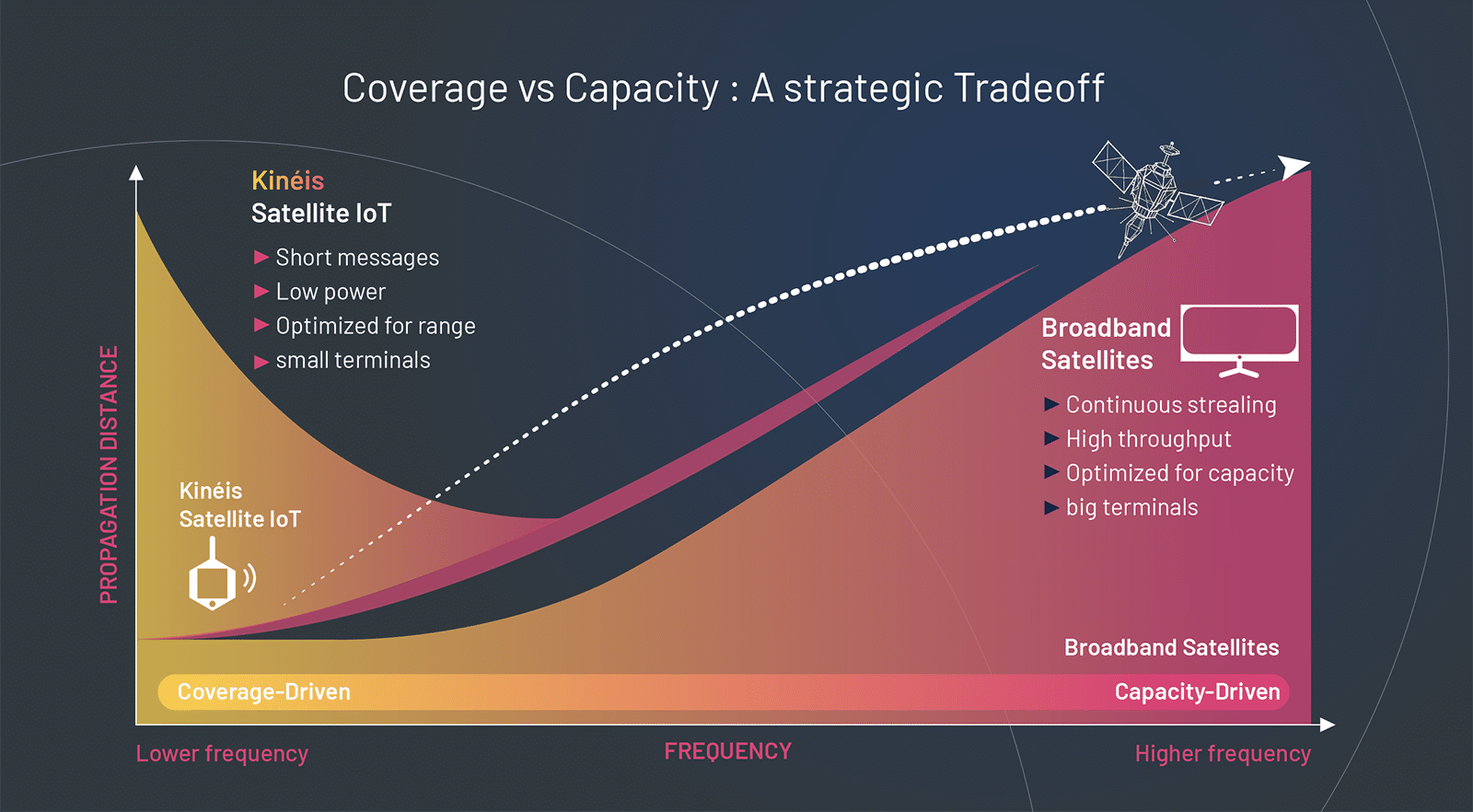
Different uses, different models: broadband vs. satellite iot
Not all satellite systems use spectrum in the same way.
Broadband constellations are designed to carry large volumes of data continuously. Their performance is driven by capacity and throughput.
Satellite IoT follows a different model:
- transmission of small amounts of data,
- short, intermittent messages,
- devices designed for low energy consumption and long lifetime.
This approach is particularly suited to:
- remote monitoring,
- environmental data collection,
- asset tracking (e.g. maritime, logistics, rail),
- infrastructure supervision.
Rather than maximizing throughput, satellite IoT optimizes coverage, efficiency, and reliability.
| Broadband | Satellite IoT |
|---|---|
| Continuous transmission | Short bursts |
| High throughput | Low data volume |
| Capacity-driven | Coverage-driven |
| Power-intensive, best for fixed services | Low power, best for mobile services |
| Bulky & Costly user devices | Small, low-cost devices, massive in number |
Kinéis: a spectrum strategy designed for efficiency
Kinéis’ approach is based on a simple principle: using spectrum efficiently to meet real-world IoT needs.
The system operates in the UHF band (Mobile-Satellite Service), chosen for its propagation characteristics:
- reliable transmission over long distances,
- robustness in complex or obstructed environments,
- compatibility with low-power devices.
This enables connected objects to operate for years on battery, even in isolated or mobile contexts.
The network is designed around short, targeted transmissions. Devices use the spectrum only when needed, for a fraction of time, allowing a large number of terminals to share the same resource efficiently.
This model supports scalability while preserving spectrum quality over time.
Kinéis Constellation: global use cases enabled by an effective spectrum strategy
Kinéis’ spectrum strategy is fully implemented through an operational constellation of 25 low-Earth-orbit satellites.
This infrastructure enables:
- global coverage, including remote and underserved areas
- connectivity for applications such as:
- wildfire detection and environmental monitoring,
- maritime and logistics tracking,
- infrastructure and asset supervision.
By combining space and ground segments, the system delivers a reliable data layer where terrestrial networks reach their limits.
Looking ahead: towards converging connectivity ecosystems
Satellite connectivity is evolving toward greater integration with terrestrial networks.
Frequency bands in the S-band (around 2 GHz) are part of this evolution, offering opportunities to support emerging standards such as Non-Terrestrial Networks (NTN) and broader mobile ecosystem compatibility.
These developments illustrate how spectrum continues to evolve alongside technologies, supporting new types of services and integration models.
A discreet but decisive foundation
Spectrum is not always visible, but it underpins every satellite transmission.
It enables systems to operate, structures how they coexist, and supports the development of sustainable, scalable connectivity solutions.
In an increasingly connected world, efficient and responsible spectrum use is essential to ensure that satellite services can continue to deliver value, reliably, globally, and over the long term.
Frequently Asked Questions
Others News








About us
Created in 2018, Kinéis is a satellite IoT operator.
© Kinéis - All rights reserved
Contact us
Adress
11, rue Hermès
31520 Ramonville-Saint-Agne
France
Phone
+ 33 5 61 39 47 00


