

The IoT Revolution Is Here
Is Your Portfolio Built for It?

Your customers are already deploying sensors, connected devices, and data platforms. The question is no longer whether IoT is relevant, it is whether you are the one selling it. For VARs, this shift represents a major strategic opportunity: moving from a transactional sales model to a high-value, recurring service model built for the long term.
Agriculture, energy, environment, logistics, maritime… Across these fast-moving industries, organizations are looking to better monitor their distributed assets, often remote, always critical. Sensors, connected devices, data platforms: IoT is opening a new field of value. And for solution providers, it is opening a new field of possibility.
Connectivity, device lifecycle, integration complexity, business model sustainability… The questions are legitimate. But they should not slow down your agility. In this article, we explore why IoT is becoming a structural growth lever for VARs, and how satellite connectivity can radically expand your addressable market.
The Big Picture: Why IoT is a game-changer for vars
For years, selling hardware or one-off solutions was the backbone of the VAR model. That model is being reinvented. Your customers now expect connected systems capable of generating continuous insights, predictive alerts, and lasting operational value.
IoT is no longer a differentiator, it is a revenue engine. For VARs who seize it, it means scalable services, long-term contracts, and deeper customer relationships.
High-growth markets, underserved needs
Whether it is irrigation systems spanning thousands of hectares, environmental sensors deployed in forests or coastal zones, or energy infrastructure stretching across vast territories, one reality stands out: a large share of your customers’ operational assets sit outside the reach of traditional network coverage.
This is precisely where IoT delivers the most value. When an asset is remote, difficult to access, or costly to inspect manually, real-time data can transform operations. It enables anomaly detection before failures occur, reduces field visits, and supports better decision-making without driving up operational costs.
Agriculture, energy, utilities, maritime, environmental monitoring: these sectors are rapidly adopting connected solutions. For VARs, this represents a fast-expanding market, one that is often underserved due to the lack of adequate connectivity options.
The real obstacle: connectivity beyond the coverage map
In dense urban or industrial environments, terrestrial networks (4G, LPWAN) provide adequate coverage. But as deployments move further from populated areas, coverage becomes inconsistent or disappears entirely. Rural sensors, maritime assets, cross-border infrastructure: these use cases require a different approach.
For VARs, this constraint has long been a real barrier: either declining certain projects or redesigning them around network availability rather than the customer’s actual operational needs. That compromise is no longer acceptable in a market where satellite connectivity is finally making these projects viable.
Satellite IoT connectivity: a strategic asset for your portfolio
Satellite connectivity is no longer reserved for niche applications or outsized budgets. It is becoming a key component of modern IoT architecture, including large-scale deployments.
Covering the unreachable: where terrestrial networks stop
Satellite IoT enables connectivity wherever terrestrial infrastructure cannot go. Instead of designing solutions around network constraints, you design around your customers’ operational needs. That is a paradigm shift, one that unlocks unexpected opportunities.
In practice, satellite connectivity allows you to:
- Deploy monitoring solutions across agricultural land spanning thousands of hectares
- Collect environmental data in isolated areas (forests, coastlines, mountains)
- Monitor extended energy infrastructure with no dependence on cellular coverage
- Manage mobile or offshore assets with guaranteed service continuity
- Execute cross-border projects without reliance on local network availability
A hybrid approach for maximum flexibility
Satellite connectivity does not replace terrestrial networks, it complements them. Hybrid architecture allows devices to transmit via cellular networks where coverage exists and automatically switch to satellite when assets move beyond covered zones.
This model ensures uncompromised service continuity while optimizing connectivity costs. For VARs, it means being able to offer robust solutions that perform reliably in any geographic context.
Long lifespan, high reliability: decisive advantages for long-term deployments
IoT deployments are built to last. Ten years, sometimes more. In this context, connectivity reliability is not a technical detail, it is the foundation of the service you deliver.
Operators like Kinéis are building satellite infrastructure specifically designed for low-power IoT applications. These networks support long device lifecycles while maintaining stable coverage, even in the most demanding environments. A major strategic advantage for VARs committed to guaranteeing their service levels over time.
What holds VARs back, and how to overcome it
Despite real opportunities, many VARs approach IoT with caution. These reservations are legitimate. Here are the most common ones, and how the ecosystem is addressing them.
The perceived complexity of IoT projects
Devices, connectivity, platforms, data management… An IoT project involves more components than a traditional system integration. But the ecosystem has matured considerably. Simplified fleet management platforms, specialized partners, connectivity technologies built for IoT: the tools now exist to integrate these solutions without significantly increasing operational overhead.
Managing device lifecycle at scale
An IoT deployment can span ten years or more. This demands a connectivity strategy, hardware architecture, and data management approach all designed for longevity. Planned correctly from day one, this constraint becomes an advantage, one that drives long-term service contracts and deepens the customer relationship.
Transitioning to a recurring revenue model
IoT naturally shifts the center of gravity of your revenue: from one-time sales to subscriptions and managed services. This transition requires adapting your commercial model, pricing, bundling, and customer relationship management. But once structured, it generates revenue predictability and recurring income that hardware sales simply cannot match.
From opportunity to execution: a 5-step structured approach
Identifying IoT opportunities is one thing. Turning them into scalable, profitable solutions is another. Here is the approach that successful VARs follow when building their IoT capabilities.
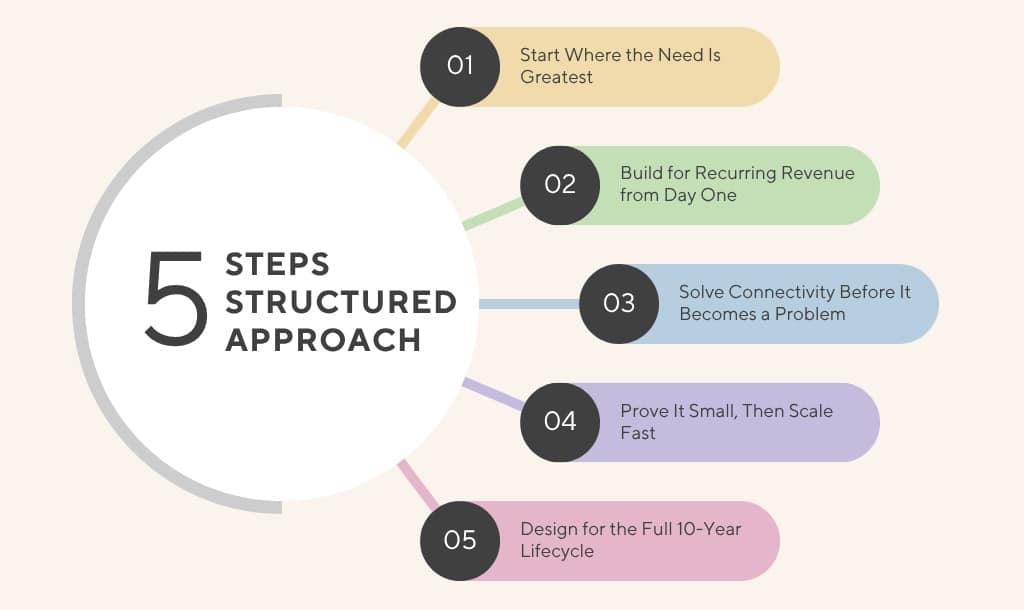
Step 1: Start Where the Need Is Greatest
The most successful IoT deployments start with a clearly defined industry challenge. Rather than targeting multiple markets at once, focus on sectors where connected monitoring delivers immediate operational value: agriculture, utilities, energy, environmental monitoring, maritime. These industries operate remote, often unconnected assets: with a real need for real-time visibility.
Step 2: Build for Recurring Revenue from Day One
Bundle hardware, connectivity, and monitoring services into an integrated offering. This model simplifies adoption for your customers while creating predictable, recurring revenue. Well-structured IoT contracts are designed to grow alongside your customers’ operations: and scale with them over time.
Step 3: Solve Connectivity Before It Becomes a Problem
Connectivity must be evaluated at the start of the project, not after. Available coverage, power consumption, data transmission volumes: these parameters directly impact real-world performance. For remote deployments, building in a satellite or hybrid option from the outset prevents costly redesigns down the line.
Step 4: Prove It Small, Then Scale Fast
Before scaling, validate. A pilot allows you to assess real device performance, refine operational processes, and identify optimization factors. These field insights are essential for ensuring that large-scale deployments run smoothly from day one.
Step 5: Design for the Full 10-Year Lifecycle
An IoT deployment is not a static installation. Provisioning, monitoring, firmware updates, data continuity: these elements must be anticipated. Efficient fleet management tools and reliable connectivity partners reduce the need for physical interventions and ensure the scalability of your offering.
Where does your organization stand? Assess your IoT readiness
Every VAR starts from a different point. Some already manage connected solutions but are looking to expand their geographic or vertical reach. Others are exploring for the first time how IoT could transform one-off installations into recurring service models.
In all cases, one thing is clear: expanding your IoT portfolio does not require an internal revolution. It is about identifying where connected solutions can generate the most value, for your customers, and for your business.
The Kinéis IoT diagnostic: your starting point
To help solution providers evaluate their positioning and identify growth opportunities, Kinéis has developed a short IoT Diagnostic specifically designed for VARs. In just a few minutes, this assessment gives you a clear picture of your current maturity, and the expansion levels you can activate.
IoT Opportunity Assessment for VARs
Others News








About us
Created in 2018, Kinéis is a satellite IoT operator.
© Kinéis - All rights reserved
Contact us
Adress
11, rue Hermès
31520 Ramonville-Saint-Agne
France
Phone
+ 33 5 61 39 47 00


