

Use Case
Water Quality & Satellite IoT:
Stay in Control, Even Off-Grid
Monitor water quality continuously, anticipate pollution, improve responsiveness, and stay compliant.
At a Glance

Issues
Aquifers, rivers, water intakes: without continuous monitoring, pollution peaks go unnoticed and alerts come too late.

Solutions
Autonomous multi-parameter sensors connected via satellite. Continuous monitoring with no reliance on terrestrial networks.

Impacts
Reduced health risks. Fewer field visits. Automated alerts. Compliance with evolving regulations.
Issues
Invisible, yet critical
Pollutants infiltrate water systems (aquifers, rivers, reservoirs) without always being detected in time. This lack of data exposes populations, agriculture, and industrial operations to underestimated risks—often identified too late.
Diffuse pollution, still poorly measured
Pesticides, nitrates, heavy metals, PFAS, pharmaceutical residues… many pollutants remain under-detected due to:
- Infrequent spot sampling
- Long analysis turnaround times
- Inability to trigger real-time alerts
Meanwhile, contamination continues to spread.
Increasingly strict regulatory thresholds
The European Drinking Water Directive now requires enhanced monitoring of emerging pollutants:
- PFAS
- Microplastics
- Pharmaceutical residues
- Requirement: trigger immediate alerts when thresholds are exceeded.
This trend is global:
- Stricter regulations
- More frequent inspections
- Higher traceability requirements
Yet current tools remain insufficient.
Lack of connectivity in critical areas
Monitoring still often relies on manual sampling—slow, costly, and not very responsive.
In remote areas—rural boreholes, agricultural zones, natural reserves—there is often no network coverage to automate data collection.
Result:
- No continuous data
- No alerts
- No remote management

Invisible pollution
59 % of European rivers and 35 % of lakes exceed regulatory thresholds for PFOS, a “forever” pollutant.

Global exposure
80 % of diseases in developing countries are linked to contaminated water (WHO).
Worldwide, at least 1.7 billion people use a contaminated drinking water source.

Risk aggravated by drought
Less water = higher pollutant concentration + rising costs.

+30 millions
water monitoring points worldwide need to be equipped or upgraded (ESSEC stydy, 2026)
+12.5%
the smart water market is growing annually.
Solutions
Monitor water quality anywhere, anytime

Seamless connectivity
Direct satellite transmission, even without terrestrial networks.
No local relay or gateway needed.

Continuous monitoring
Near real-time measurements, nitrates, PFAS, pH, turbidity…
Detect anomalies before they become critical.

Risk
reduction
Automatic alerts as soon as a threshold is crossed.
Fewer pollution events, faster responses.

Ready-to-use
data
Time-stamped data integrated into your business tools.
Actionable reports for audits, compliance, and alerts.
VisioHub: a ready-to-deploy field solution
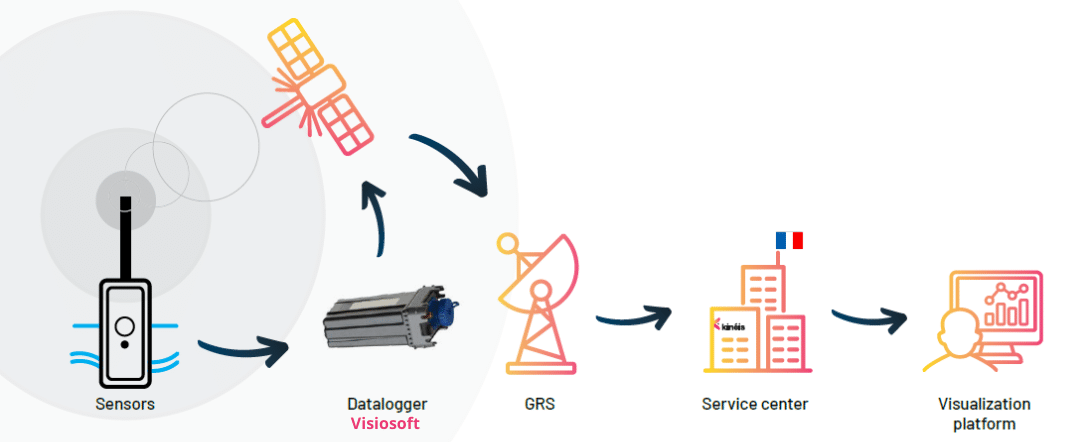
For on-site water quality monitoring, solutions like VisioHub—developed by Visiosoft and compatible with Kinéis connectivity—make it easy to connect multi-parameter sensors, even in remote areas.
This IoT gateway acts as a smart data logger, capable of continuously collecting and transmitting data (pH, turbidity, nitrates, etc.).
VisioHub integrates seamlessly with terrestrial networks (cellular, LoRaWAN, Ethernet) as well as Kinéis satellite connectivity, enabling intelligent hybrid communication.
A simple solution to ensure continuous and reliable water quality monitoring, anywhere.
Impacts
Concrete benefits for monitoring operations
Fewer blind spots, greater visibility
Without continuous monitoring, pollution spikes can go unnoticed for days. With satellite IoT, even the most exposed sites are monitored without interruption.
Reliable alerts for better decision-making
Alerts are triggered automatically when thresholds are exceeded, enabling informed decisions—whether to initiate sampling or adjust treatment processes.
Optimized resource allocation
No more systematic sampling across all sites. Data helps prioritize critical locations, optimize field operations, and improve efficiency.
Enhanced traceability
All data is timestamped, secure, and usable. This simplifies reporting, regulatory compliance, and communication with authorities.
Continuous monitoring
24/7, even off-grid.
Optimized operations
Immediate detection of anomalies.

Real-time
alerts
Fewer unnecessary field visits.

Easier
compliance
Ready-to-use regulatory data.
FAQ
Water Quality & Satellite IoT
Stay in control with continuous monitoring
Satellite IoT enables early detection of pollution, reliable alerts, and compliance with regulatory requirements.
A robust, accessible, and operational solution—available today.
Others Use Cases


About us
Created in 2018, Kinéis is a satellite IoT operator.
© Kinéis - All rights reserved
Contact us
Adress
11, rue Hermès
31520 Ramonville-Saint-Agne
France
Phone
+ 33 5 61 39 47 00


